Sunday, August 26, 2018

52 Ancestors in 52 Weeks - Week 34 - Non-Population Schedules

The 52 Ancestors prompt for this week is "Non-Population".

The federal census that we use in the US is sometimes comprised of more than one schedule. The one that we usually use is called the "population schedule." However, there are some censuses that have addtional schedules, such as:
- 1850-1880 Agricultural schedules
- 1850-1880 Industry and Manufactures schedules
- 1880 Defective, Dependent, and Delinquent Classes
- 1890 Schedule of Union Veterans and Widows

Have you found your ancestor on one of these schedules? What did you find?


I've found quite a lot of information in the non-population schedules. Here are a few of my previous posts about them:

Timothy Creeden - Down on the Farm - The 1880 Agricultural schedule was one of my favorite finds since it gave me so much insight into the farming life of my 2x great-grandparents Timothy and Mary Creeden in Clinton County, Ohio. I'd pictured fields of single crops like corn or wheat, but they had so much more going on!

Hannah Hoover Creedan - 1880 Mortality Schedule - This schedule lists information about people that died in the year before the 1880 census was taken. It links the deceased to their family in the 1880 census and gives some additional information such as cause of death and length of residence in the county. Hannah lived in Clinton County, Ohio and was the second wife of my 3x great-grandfather Patrick Creedan.

John Matson in 1890 Schedule of Union Veterans and Widows - This schedule provided more insight into John Matson's service and included the reason for his disability which was "wounded hand".

This last one is a bit of a mystery. I was surprised to find a Mary A. Matson in the 1880 Agricultural schedule for the Hopewell township of Mercer County, Ohio. According to the schedule, she was renting the farm land for a fixed amount of money. The rest of the information on the schedule is blank for Mary, so maybe she wasn't actively farming the land.


I would guess this was the same Mary Matson listed in the 1870 census for Mercer County. If so, she was born in Virginia in 1833. This is intriguing since my Matson family came from Virginia to Clinton County, Ohio. It appears that some of the Matsons went to Mercer County instead, so I'll have to see if I can figure out her relationship to my Matsons.

One thing to be aware of is that the non-population schedules are only available online for certain states. This is the information for the schedules available on Ancestry.com: "This database contains U.S. federal non-population schedules from 1850-1880 for the following states: California, Georgia, Illinois, Iowa, Kansas, Maine, Massachusetts, Michigan, Nebraska, New York, North Carolina, South Carolina, Texas, Virginia, and Washington Territory. Additional states will be added in the future. Non-population schedules contained in this database include: agriculture, industry/manufacturers, social statistics, and supplemental schedules".

#52Ancestors is a series of weekly family history prompts developed by Amy Johnson Crow.

Sunday, August 19, 2018

52 Ancestors in 52 Weeks - Week 33 Family Legend - A Bible and a Gun

The 52 Ancestors prompt for this week is "Family Legend". It isn't unusual for a family to have some sort of legend. Maybe it's a legend surrounding the family's arrival in a country or that there's an ancestral castle waiting to be claimed. Maybe it's a story about how you're supposedly related to someone famous. You could explore how you proved or disproved the story. Then there are the "tall tales" that seem to get taller at every telling!

My father told me quite a few stories about his grandfather's adventures as county sheriff during the 1920s. Charles Creeden was the County Sheriff of Mercer County, OH from 1923-1927. One legend I've been able to prove during Charles' time as sheriff involved a skirmish at the opening of the Mercer County courthouse where Charles turned the fire hoses on an unruly mob. I was also able to find an article about the arrests of farmers for having stills (or hootch!) on their farms during prohibition.

Another of my father's stories involved a gunfight that broke out when Charles and his deputies tried to serve papers on a local pastor. They approached the person in question on his way to church and he pulled a gun out from under his bible and shot at them! A bullet grazed Charles in the head and left a scar. The sheriffs shot back and the shooter was arrested.

I've searched for a newspaper article on this story before with no luck, but this time I had some success.


The above article was published in the News-Journal in Mansfield, OH on March 24, 1925 and is available on Newspapers.com. It seems to confirm most of the story. It's interesting that it doesn't mention Charles being shot, but I'm guessing the injury was fairly minor. It also doesn't mention the details about a pastor or pulling the gun out from under a bible, so hard to say if that is true or if my great-grandfather was just adding a bit of color to the story! Given that Hein was on his way to church, it certainly seems possible.

One final thing I wondered about was the levy of execution mentioned in the article. According to Nolo.com, this is a court order authorizing a levy on (or seizure) of property or other asset to satisfy a creditor. No wonder Mr. Hein didn't want to answer the door when the sheriffs came to his house!

#52Ancestors is a series of weekly family history prompts developed by Amy Johnson Crow.

Sunday, August 5, 2018

52 Ancestors in 52 Weeks - Week 31 - Oldest - Photo from the 1860s?

The 52 Ancestors prompt for this week is "Oldest". How are you going to interpret "oldest"? The oldest child in one of your ancestral families? The oldest photo you have? The oldest document you've ever found? The oldest ancestor you ever met?

This prompt reminded me that I have a mystery photo that I'm still curious about. I first posted about this in 2012, but wanted to see if I could find some new information. 

My grandmother gave this photograph to my mother, but the identity of the woman in the portrait is a mystery. My mother's family was from Queen Anne's County, Maryland and the surrounding areas. Some of the surnames in my grandmother's family are Willis, Chilcutt, Adams, and Covey, so it's possible that the woman is from one of these families.


The photograph is in a hinged case which opens up and has a plush velvet-like material on the left side. From everything I could find online, the style of dress looks like it could be from the 1860s. Her jewelry looks like it might have been enhanced in the photograph. The photograph is behind a glass plate which is very reflective and a bit tricky to capture with my camera. I think the photo is most likely an ambrotype.


The Daguerreian Society has some good information on the history of daguerreotype and ambrotype photographs and their cases. The outer case for this photograph looks like a Union Case which dates it to sometime from 1855-1865. A Union Case was a mixture (or union) of shellac and wood fibers that were pressed into a steel mold. Phototree.com has some examples of women's clothing that also leads me to believe the photo is from this time period.


I wondered if the design on the case could shed any light as to its origins or time period. I found a match for the case on CivilWarTalk.com's forum where they were discussing the meaning of the six-sided star. It was mentioned there that the US Army Eighth Corps adopted the six-sided star as their insignia in the summer of 1864.

From Wikipedia, the Union Army VIII Corps badge looked like this:
A short history of the VIII Corps states that they were based in Maryland, so that at least matches the location of my mother's family. Of course, I don't even know for sure that the picture is of one of her ancestors! I can't really draw any conclusions from any of this, but it was interesting to find a match for the case. I don't know of anyone from her mother's family that served in the Civil War, but I don't have a lot of details on some of them. If anyone has suggestions on finding more out about this photograph, I'd love to hear from you!

#52Ancestors is a series of weekly family history prompts developed by Amy Johnson Crow.

Sunday, July 22, 2018

52 Ancestors in 52 Weeks - Week 29 - Music - Silent Film Pianist

The 52 Ancestors prompt for this week is "Music". This should be a fun prompt. Do you know of a musical relative? (According to my dad, my great-uncle Pete could play anything that had strings.) If not, what about an ancestor with a musical name? Place names can be musical as well. Any ancestors from New Harmony, Indiana or Trumpet Island, Maine? (Or take inspiration from classic rock: Chicago, Boston, Kansas... What was it in the '70s with naming bands after places?) I can't wait to see what you come up with!

Carrie Niehaus Myers was the sister of my great-grandmother Anna Niehaus Creeden. According to family stories, Carrie was a fantastic pianist and one of her jobs was playing piano at a theater during the silent film era. The 1910 census for Mercer County, Ohio shows Carrie was playing piano at a theater as early as age 17.


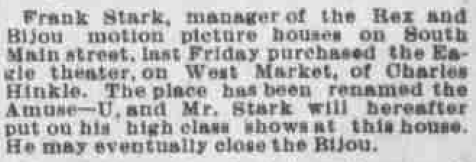
I was hoping to find some information on where she played, but haven't had any luck so far. Three theaters are mentioned in an article published in The Celina Democrat on September 4, 1914: The Rex and Bijou motion picture houses and The Eagle Theater. I would guess she played at one of them.

The Celina Democrat, September 4, 1914
By 1920, Carrie was busy as a wife and mother. She was married to Charley Myers and they had a 5 year old daughter named Marjorie. While she was no longer employed as a pianist, she continued to entertain family and friends for many years.

#52Ancestors is a series of weekly family history prompts developed by Amy Johnson Crow.

Sunday, July 15, 2018

52 Ancestors in 52 Weeks - Week 28 - Travel

The 52 Ancestors prompt for this week is "Travel". Travel is a part of many of our ancestors' lives. Traveling across an ocean or a continent for life in a new land. Traveling to a different state to elope. Traveling for work, either as a salesman or working the railroads or canals. Traveling for vacation. What ancestral travel tales have you found?

When I first started researching my 2x great-uncle Edward Creeden, I found military records from several places in the US, Canada, Europe and the Philippines. The records were from the US Army, US Marines, and the Canadian Expeditionary Forces. At first, I didn't think they could all be for the same person, but I was able to find Edward's birthplace of Celina, OH in most of the records. 

I volunteered to do some beta testing for HistoryLines.com when it first came online and I entered Edward's data in their story format to try out their map features.  The map below from HistoryLines indicates Edward's destinations with a red dot and I've bolded each of his destinations in the text that follows.


Edward was thought to have been born in April 1884 in Celina, OH. His military records support this date and place, but I haven't located a birth record for him. Edward joined his sisters Mary Elizabeth and Julia in Pueblo, CO around 1903. In 1904, he enlisted in the US Army in Salt Lake City, Utah

Edward was discharged from the 12th Infantry Company D in 1907 in Fort Porter, NY with this note in the return from service record: Service honest, faithful Character Excellent. He next enlisted in Columbus, OH on January 18, 1907. His description was given as: Born in Celina, OH, 24yrs, 9mths, Soldier, Blue eyes, Drk Brn hair, Fair complexion. This time he was in the 30th Infantry, Company L.

Edward served as a Corporal in Regiment 30, Company L in the Philippines. His date of arrival at the post was 7/1/1908 and the location was given as Camp Gregg, Pangasinan, Philippine Islands. He was on "topographical duty", and returned to his company on Aug 14, 1908. He was discharged from the Army on 1/17/1910.

After his discharge from the Army, Edward enlisted in the US Marines from San Francisco, CA. His rank was Private and his enlistment date was 1/27/1910. Edward transferred from the Cal Recruiting District to the Navy Yard in Puget Sound, Washington.according to Marine Muster Rolls for 1910.

In October 1911, Edward mysteriously disappeared from his post at the Navy Yard in Puget Sound, Washington. A reward was put out for his return, but no further paperwork was in his file. The next place he shows up is at Vancouver Barracks, Washington where he reenlisted in the Army! He seemed to have an uneventful stint in the Army and was honorably discharged on January 15, 1915.

Edward enlisted in the Canadian Expeditionary Forces in 1917 and gave his current residence as Minneapolis,MN. In September 1917 he was transferred to the #1 British American Division and traveled via ship from Halifax to Liverpool, England. He arrived in France on February, 8, 1918.

On April 9, 1918, Edward was wounded in battle in Arras, France and spent 10 days in Etaples at a French War Hospital where his right leg was amputated. He spent two months recovering at the Horton War Hospital in Epsom, Surrey, England and was then sent back to the Granville Canadian Special Hospital. He also spent time at the
Whitby Military Hospital in Ontario, Canada

A letter to his brother Joshua published in the Celina Democrat on July 26, 1918 says that Edward also was stationed in Honolulu and the Mexican border.


Edward was dismissed from the Canadian Forces in Toronto, Ontario, Canada due to being medically unfit. His proposed residence was St. Louis, MO. I haven't found any definite records for him there, but in 1920, a census record matching Edward shows he was possibly living in Sedgwick, KS

A 1930 census record shows that Edward might have been living near Detroit, MI where his brother Joshua was living. Edward died when he was 52 years old in Newport, Campbell, Kentucky, United States. He is by far the most well traveled person I've found in my family tree!

#52Ancestors is a series of weekly family history prompts developed by Amy Johnson Crow.