Showing posts sorted by relevance for query ancestry chart. Sort by date Show all posts

Sunday, February 21, 2016

Mystery Monday - Making Sense of DNA Ethnicity Results

A few years ago I created an ethnicity chart based on what I knew about the origins of the main lines in my family tree.


This chart assumes that percentages were passed straight down through each generation, so a great-great grandparent represents 6.25% of my ancestry. I know the DNA passed down is much more random than that, so this was just a guesstimate at best.

For this chart, I put my Mom's origins at 100% British, but I've since found out that she may have some other European and Irish roots. My Dad's heritage was about 64% German, 12% Irish, 12% French, and 12% British/Unknown on paper. That gave me the following percentages:

British  - 55%
German - 31%
Irish  - 6.25%
French - 6.25%
Unknown - 1.5%

My Mom and I had our DNA tested through Ancestry.com last year, so I was curious to compare the DNA results to my original estimates based on my paper tree.

Here's my breakdown from Ancestry.com:


The first mystery was what happened to my Irish and German heritage? The second was where did all the Scandinavian DNA come from? I can guess that at least some of my German and Irish heritage is showing up as Scandinavian and/or British.

Even more surprising was my Mom's chart which looked more like what I expected mine to look like. She came up with 54% Great Britain, 27% Europe West and 13% Ireland and only 3% Scandinavian.

Given, that 50% of our DNA comes from each parent, this seems to indicate my Dad had a much higher percentage of British and Scandinavian roots than I can account for. Even if all of the DNA I inherited from my Mom was from her British lines, that would mean 23% of the British came from my Dad.

I transferred my results to Family Tree DNA and got the following breakdown:


Their definition of British Isles includes Ireland. This looks closer to what I expected, but shows an even larger Scandinavian percentage. On this chart, I have 22% Western and Central Europe vs. the 3-6% from Ancestry.com.  My British Isles percentage dropped from 73% on Ancestry.com to 50%. That's quite a difference!

I also took a look at some of the Admixture tools on Gedmatch.com. For another comparison, here are my results with the Eurogenes EUTest:
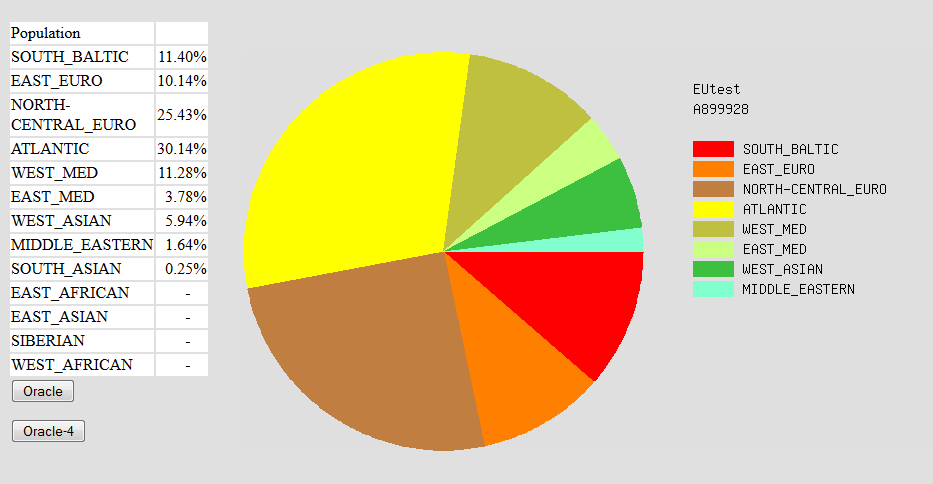

Interesting that my Mom's results are very similar to mine on the Eurogenes EUTest admixture. We both had around 30% Atlantic and 25-27% North Central Europe. Finding out exactly what the groupings mean on this chart is another challenge which I'll save for a future post.

So, what does any of this mean? Each admixture chart is based on different algorithms and population databases, so comparing them against each other doesn't mean too much. According to Ancestry.com, the number of reference samples for a region and the similarity of one region to another can affect the accuracy of the results. In particular, they state that their results for Great Britain and Europe West are less accurate than for most of the other regions.

I would think the results will become more accurate as more people get tested and the reference populations for each region are refined. While the charts are fun to look at and can provide some clues on your origins, I wouldn't draw any conclusions from them.

Friday, July 15, 2011

Follow Friday - Make an Ancestry Pie Chart

Family Tree Magazine's Genealogy Insider Blog by Diane Haddad had a fun exercise this week on making a pie chart to show the ethnic heritages that make up an individual's ancestry. She used a simple online pie chart generator at Kid's Zone to create the chart.

Here's the chart I came up with for my ancestry:


My lines aren't too complicated, so it was fairly easy to halve each of my parents lines to get the numbers. They both have some British ancestry, so I added the percentage from each of them. Of course, this is just an estimate and subject to change when I find out more on my ancestry, but it's a quick and easy way to take a look!

Friday, January 12, 2024

52 Ancestors in 52 Weeks - Origins

The theme for this week is "Origins". Genealogists often get the question, "Where is your family from?". 

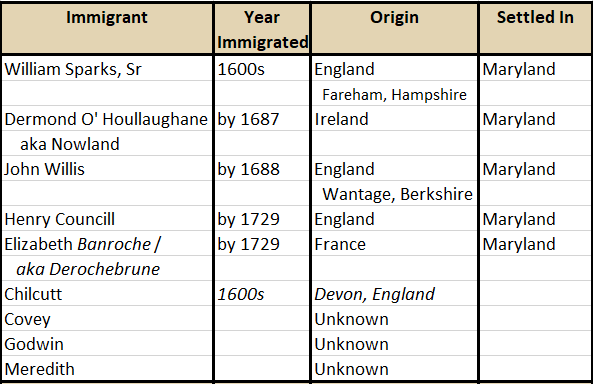
I do get asked that question, so I'm using this post to document what I know about my family's origins and what is still a mystery. Most of my maternal ancestors eventually settled in Queen Anne's County, Maryland or nearby counties. The chart below shows some of my maternal immigrant ancestors and my best guess at where they're from. Italics indicate data where I haven't found any supporting records. While some of these lines can be traced down to my ancestors, some of them get a bit murky in the middle and it's presumed that my lines are related to the immigrant ancestors.

The origins of my Chilcutt, Covey, Godwin and Meredith ancestors are unknown and I haven't traced my Councill line back further than Henry Councill. There was a Dennis Councill/Councell in the estate records of a Jacobus Seth in Talbot County, Maryland as early as 1698. It's possible that he is Henry Councill's father or other relation, but I haven't seen any proof of that so far.

Maternal Immigrant Ancestors

The next chart shows the main lines for my paternal immigrant ancestors. Most of them arrived in the US in the 1800s so the relationships are easier to prove than with my maternal side. The exceptions are my Matson and Clevenger lines. John Matson still remains mostly a mystery. He is the ancestor of my great-great-grandmother Mary Ann Matson Creeden. He was married to Nancy Ann Clevenger and they moved from Virginia to Clinton County, Ohio in the early 1800s. Mary is also related to the Clevengers through her mother Dortha Clevenger.


Paternal Immigrant Ancestors

A final note is that these origins match up pretty well with the ethnicity estimates from Ancestry DNA tests for me, my sister and my mother. My estimates show roughly 1/3 England/NW Europe, 1/3 Germanic Europe and 1/3 a  mix from Wales, Scotland, Ireland and Sweden/Denmark. The English and Welsh are from my maternal side, while the Germanic Europe and Sweden/Denmark are paternal. I have Irish and Scottish ancestry on both sides. The Meredith surname originated in Wales, so that's a possibility for the Welsh ancestry.

#52Ancestors is a series of weekly family history prompts developed by Amy Johnson Crow.